
BUILT IN · PRE-ORDER
Era 57 Gen 2
The new Era ships with Atmo on board — the wind page, the airmass vario and the thermal average, from the first flight.
Explore Era 57 Gen 2 →Atmo reads the wind on every straight kilometre and in every circle — direction, speed and the vertical motion of the air — with no compass, no second antenna and no extra probe.
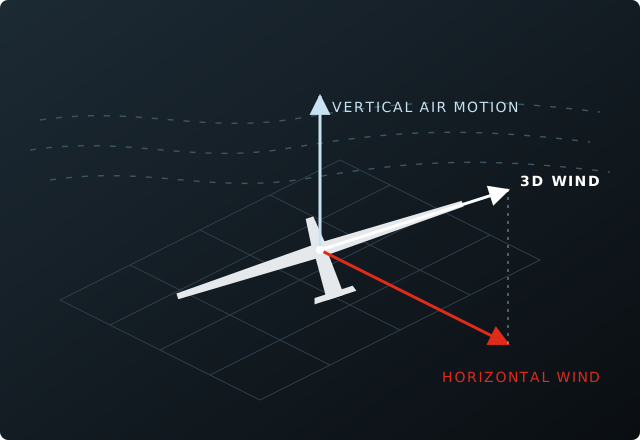
A wind arrow used to be a direction and a speed, refreshed whenever you happened to circle. Atmo makes it a live, three-dimensional measurement of the air you are flying through.
Every other wind display gives you two numbers. Atmo adds the third: how fast the air itself rises or sinks around you. That is the netto vario — measured from the airmass, not inferred from a probe that also feels every gust.
Classic instruments learn the wind from the drift of your circles and hold it between thermals. Atmo solves the wind triangle continuously, so the number is fresh on the glide, on the ridge and on the final glide.
Heading comes from the physics of motion — inertial sensors, GNSS and airspeed fused a hundred times per second — so there is no magnetometer to calibrate and no second GNSS antenna to route through the fuselage.
Wind and climb averaged over exactly the last full circle, not a sliding clock — so what you see is the thermal, not the gust that hit you on the upwind side.
A horizontal gust changes airspeed, not the airmass. Atmo tells the two apart, so the needle shows lift — not the bump.
Pitot position error and air density are learned in flight. Nothing to enter, nothing to trust blindly.
Ground velocity comes from GNSS. Air velocity comes from the pitot and from attitude. The difference between the two vectors is the wind — in three dimensions, if you know where the nose points and how the fuselage sits in the air. Atmo knows both without a compass.
Most instruments infer the wind from the drift of your circles. Some add a compass to solve it in straight flight; some add a second GNSS antenna instead. Atmo does it with the sensors already in the instrument.
The headwind on your glide is the wind of the last minute — not the wind of the last thermal.
Vertical air motion shown where you are: entering a thermal reads as lift before the glider has climbed a metre.
Shear across the ridge, the rotor edge, the wave band — live wind at every heading, no circling required.
Gusts move the airspeed needle, not the vario. What you hear is the airmass.
The new Era ships with Atmo on board — the wind page, the airmass vario and the thermal average, from the first flight.
Explore Era 57 Gen 2 →Instruments already in your panel carry the sensors Atmo needs. A software upgrade switches it on.
Buy the licence →The Navia sensor unit with Atmo activated — 3D wind and airmass vario for the whole Navia panel.
Explore Navia Sense →No. Heading is derived from the motion of the glider — inertial sensors against GNSS velocity — so there is nothing to calibrate and nothing that ferrous ballast, wiring or a phone on the glareshield can disturb.
No. One GNSS receiver is enough. Atmo does not measure heading between two antennas; it observes it from the flight path itself.
It is the vario a glider pilot actually wants: the motion of the air, separated from the motion of the glider. It does not react to a horizontal gust or to a pull-up, and it reads lift on entering a thermal before the glider has started to climb.
Era 80 and Era 57 carry the sensors Atmo needs. A software upgrade activates it — ask your dealer or see the shop.
Every Atmo number carries its own confidence, and the display goes blank rather than guess — on the ground, in a stall, with a blocked pitot. Heading, and with it wind direction, is measured best while the glider turns, which is exactly when it matters most.
Shipping with Era Gen 2 and Navia Sense Gliding Pro+. A software upgrade for the Era in your panel.
A free online video call with LX navigation or one of our dealers — in your language, about your panel, your aircraft, your questions.
Online · free · no obligation